


August 6, 2026
Media Contact:
Tara Atrian (323) 610-9840
press@ad.lacounty.gov
Los Angeles County Officially Launches Designated Aging and Disability Resource Connection (ADRC) Network
Newly Designated Network Unifies County Departments, the City of Los Angeles, 211 LA, and Six Local Independent Living Centers Under a Coordinated “No Wrong Door” Approach to Expand Access to Services for Older Adults and People with Disabilities.
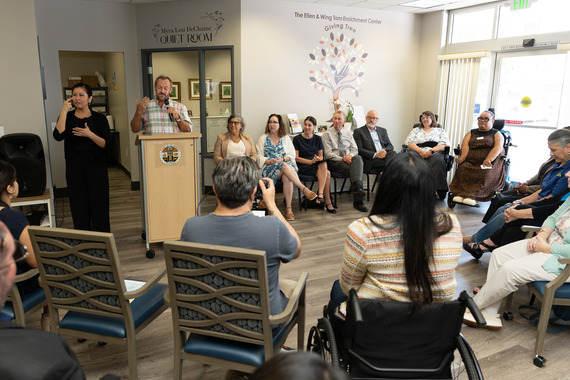
Disability Community Resource Center (DCRC) Executive Director TJ Hill speaks at the launch of the Los Angeles County Aging and Disability Resource Connection (ADRC) network on August 6, 2026 in Claremont, CA.
LOS ANGELES, CA — Today, Los Angeles County leaders, local officials, community partners, and advocates gathered at the Service Center for Independent Life (SCIL) in Claremont to celebrate Los Angeles County’s official designation as an Aging and Disability Resource Connection (ADRC) network.
Effective July 1, 2026, the State designation by the California Department of Aging (CDA) and the California Department of Rehabilitation (DOR) recognizes a countywide system designed to remove barriers, reduce bureaucratic runaround, and make it easier for older adults, people with disabilities, caregivers, and families to access long-term services and supports (LTSS).
“It shouldn’t be that hard to find help. That’s exactly why the ADRC exists,” said Maral Karaccusian, Director of the Los Angeles County Aging & Disabilities Department (AD). “The goal isn’t simply to connect people to services. It’s to make sure people don’t have to navigate the system alone. Instead of sending people from one organization to another, our partners work together to help people reach the right services through a coordinated ‘No Wrong Door’ approach.”
The Los Angeles County ADRC brings together the Los Angeles County Aging & Disabilities Department (AD), the City of Los Angeles Community Investment Department (CID), 211 LA, and six regional Independent Living Centers (ILCs) into a single, seamless support network. With a “No Wrong Door” approach, residents can reach out to any participating partner organization to receive personalized guidance, coordinated referrals, and direct connections to community resources without having to navigate multiple agencies on their own.
“Supervisor Barger has long championed collaborative solutions that improve access to county services. Today’s designation reflects years of partnership among county agencies, community organizations, and professionals who share a commitment to serving older adults, people with disabilities, caregivers, and families,” said Monica Banken, Deputy for Supervisor Kathryn Barger, Fifth District. “This achievement is about more than earning a state designation. It’s about building a stronger, more connected system that helps people find the right support more easily.”
Originally launched as an Emerging ADRC in 2022, the network underwent extensive planning and development to receive the official designated status by building the shared processes required to meet the State’s strict standards for coordinated, person-centered care.
The Los Angeles County ADRC network serves all residents regardless of age, income, or disability status, and it includes ILC partners that cover communities across Los Angeles County:
- California Resource Services for Independent Living (CRS-IL) – Downey
- Communities Actively Living Independent & Free (CALIF) – Downtown Los Angeles
- Disability Community Resource Center (DCRC) – Venice
- Disabled Resources Center (DRC) – Long Beach
- Independent Living Center of Southern California (ILCSC) – Van Nuys
- Service Center for Independent Life (SCIL) – Claremont
Keith Miller, CALIF Executive Director, noted that more than 50% of staff members at ILCs are required to have disabilities, ensuring that the programs and advocacy they deliver are directly shaped by the lived experience of the community they serve. The impact is clear in programs like CALIF’s Positive Wheels, which is a community service that provides repaired mobility gear, walkers, and equipment free or at low cost to community members with nowhere else to turn.
“This program originally started for staff. The majority of our staff at that time had power wheelchairs, and when they would break, we would be out of work. So, we hired a mechanic to come in and fix them,” said CALIF ADRC Program Director Carrie Madden.
Available supports at ILCs include information, coordinated referrals, person-centered planning, and options counseling for key issues and services like housing, meals, transportation, benefits, caregiving, health services, employment, and more.
Across the county, ILCs also fill critical gaps in their communities with unique programs. Their specialized offerings range from life-saving crisis response, such as DCRC’s youth-diversion partnership with law enforcement and emergency disaster response, to basic needs like SCIL’s door-to-door food bank serving 500+ households weekly. ILCs also drive long-term independence through practical, peer-led solutions, including ILCSC’s consumer-guided employment services and specialized community-based support for individuals with traumatic brain injuries (TBI), CRS-IL’s college retention (EDGE) program, DCRC’s mental health Peer Support Specialist workforce training, and SCIL’s nationwide production of Braille, large-print, and tactile alternative media.
“Whether someone needs help with housing, transportation, caregiving benefits, independent living services, or long-term supports, they can start with any ADRC partner and get that help,” said Jennifer Kumiyama, DRC Executive Director. “By working together with our aging and disability partners, we’re creating a system that is more responsive, more efficient, and more person-centered. No one should have to figure out a complicated system on their own, and with ADRC there is no wrong door.”
During Thursday’s press event, media and stakeholders toured the SCIL campus to observe firsthand the range of services integrated within the ADRC framework. Among those championing SCIL’s mission is Claremont Mayor Jennifer Stark, who personally volunteers every Friday to hand-deliver food to local older adults, people with disabilities, and caregivers through SCIL’s food pantry.
“No single organization can meet every need alone, but together, sharing resources and focusing on the people we serve, we can create a system that’s easier to navigate, more responsive, and more equitable for everyone,” said Stark.
SCIL consumer Natalie Webber, who lives with a disability, and her mother and caregiver Louise Webber, shared how the Independent Living Center has transformed their lives.
Louise described Natalie’s creative journey, explaining that Natalie spent years writing and adapting theatrical scripts but lacked a place where her talents and lived experiences could flourish. At SCIL, she found that opportunity. The Claremont-based center created a theater and script-reading program where Natalie and other consumers could develop their artistic talents, build confidence, and connect with others.
“One door—the most important door in her life right now—embraced her and said, ‘Sure. Script reading? Absolutely. Let’s do it,’” said Louise.
In addition to the ILCs, 211 LA, the City of Los Angeles CID, and AD are also core partners who help connect people seeking help to the ILCs and the services that they need. “211 LA receives about 2,000 calls every single day, giving us a unique opportunity to connect people who have nowhere else to turn with life-changing resources,” said Maribel Marin, Executive Director of 211 LA. “Through the ADRC network, we’ve already connected thousands of callers to our community partners for deeper support.”
Residents, caregivers, and families seeking assistance or information regarding long-term services and supports can connect with the Los Angeles County ADRC network by calling 211 LA (2-1-1), connecting with any partner organization, or by visiting AD’s website.
Media resources, including the electronic press kit, speaker headshots and bios, b-roll, interview sound bites, and graphics, are available here.
Photos from today’s press briefing, along with photos from each Independent Living Center, are available on the department’s Flickr account.
|
|
###
About the Los Angeles County Aging and Disability Resource Connection (ADRC)
The Los Angeles County Aging and Disability Resource Connection (ADRC) is a countywide partnership recognized by the California Department of Aging and the California Department of Rehabilitation as California’s designated ADRC serving all of Los Angeles County. The network brings together the Los Angeles County Aging & Disabilities Department, the City of Los Angeles Community Investment Department, 211 LA, and six Independent Living Centers to create a coordinated “No Wrong Door” network. Together, these public and nonprofit partners connect older adults, people with disabilities, caregivers, and families to trusted information, person-centered guidance, and long-term services and supports.
About the Aging & Disabilities Department
Established in July 2022, the Aging & Disabilities Department (AD) serves the Los Angeles region’s growing population of older adults and adults with disabilities through thoughtful action, compassion, and supportive programs. Through its advocacy and dedicated efforts, the department strives to empower individuals to live with dignity and independence. This mission is guided by the belief that every individual, regardless of age or ability, deserves to lead a fulfilling and dignified life, enriched by the involvement and support of their community.