


Human Trafficking
As the nation’s most populous county, Los Angeles has taken important steps to address trafficking but continues to face persistent challenges, with a large number of children and youth exploited through commercial sex and labor trafficking. This includes children who are forced or coerced into illegal activities such as drug sales, theft, or fraud—a form of labor trafficking known as forced criminality. Responding to these challenges requires a thoughtful, coordinated approach that not only considers the risk factors that make children, youth, and families vulnerable to exploitation, but also actively supports the development of protective factors that can help reduce those risks.

Human Trafficking
As the nation’s most populous county, Los Angeles has taken important steps to address trafficking but continues to face persistent challenges, with a large number of children and youth exploited through commercial sex and labor trafficking. This includes children who are forced or coerced into illegal activities such as drug sales, theft, or fraud—a form of labor trafficking known as forced criminality. Responding to these challenges requires a thoughtful, coordinated approach that not only considers the risk factors that make children, youth, and families vulnerable to exploitation, but also actively supports the development of protective factors that can help reduce those risks.
Human Trafficking
As the nation’s most populous county, Los Angeles has taken important steps to address trafficking but continues to face persistent challenges, with a large number of children and youth exploited through commercial sex and labor trafficking. This includes children who are forced or coerced into illegal activities such as drug sales, theft, or fraud—a form of labor trafficking known as forced criminality. Responding to these challenges requires a thoughtful, coordinated approach that not only considers the risk factors that make children, youth, and families vulnerable to exploitation, but also actively supports the development of protective factors that can help reduce those risks.
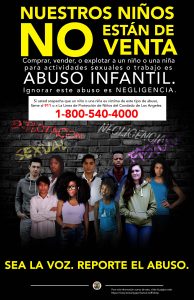
Know to Say No to Child Trafficking
Los Angeles County is one of the highest intensity child exploitation areas in the country. Human trafficking is happening everywhere in our communities and does not discriminate against ethnicity, gender, and age, nor does it take into consideration immigration or socioeconomic status. That’s why we’re excited to launch the “Know to Say No”, a campaign that empowers the community through education, awareness, and action. We want you to be informed about the recruitment methods used by exploiters to lure children into human trafficking and the signs that someone may be a victim. By understanding these warning signs, you can take action to help protect vulnerable children and youth in our community.




Labor Trafficking by Forced Criminality and Peer Recruitment
Labor Trafficking by Forced Criminality
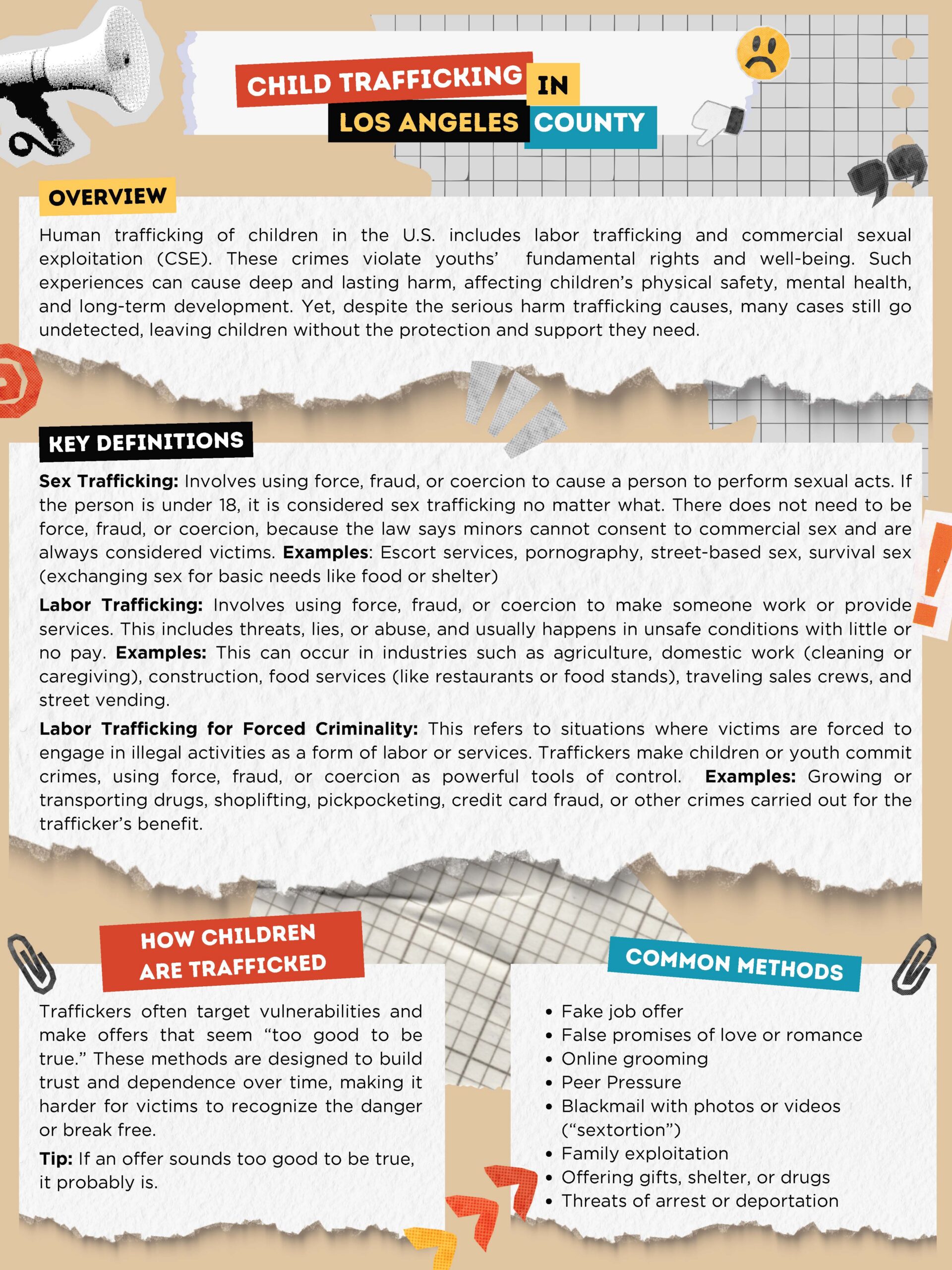
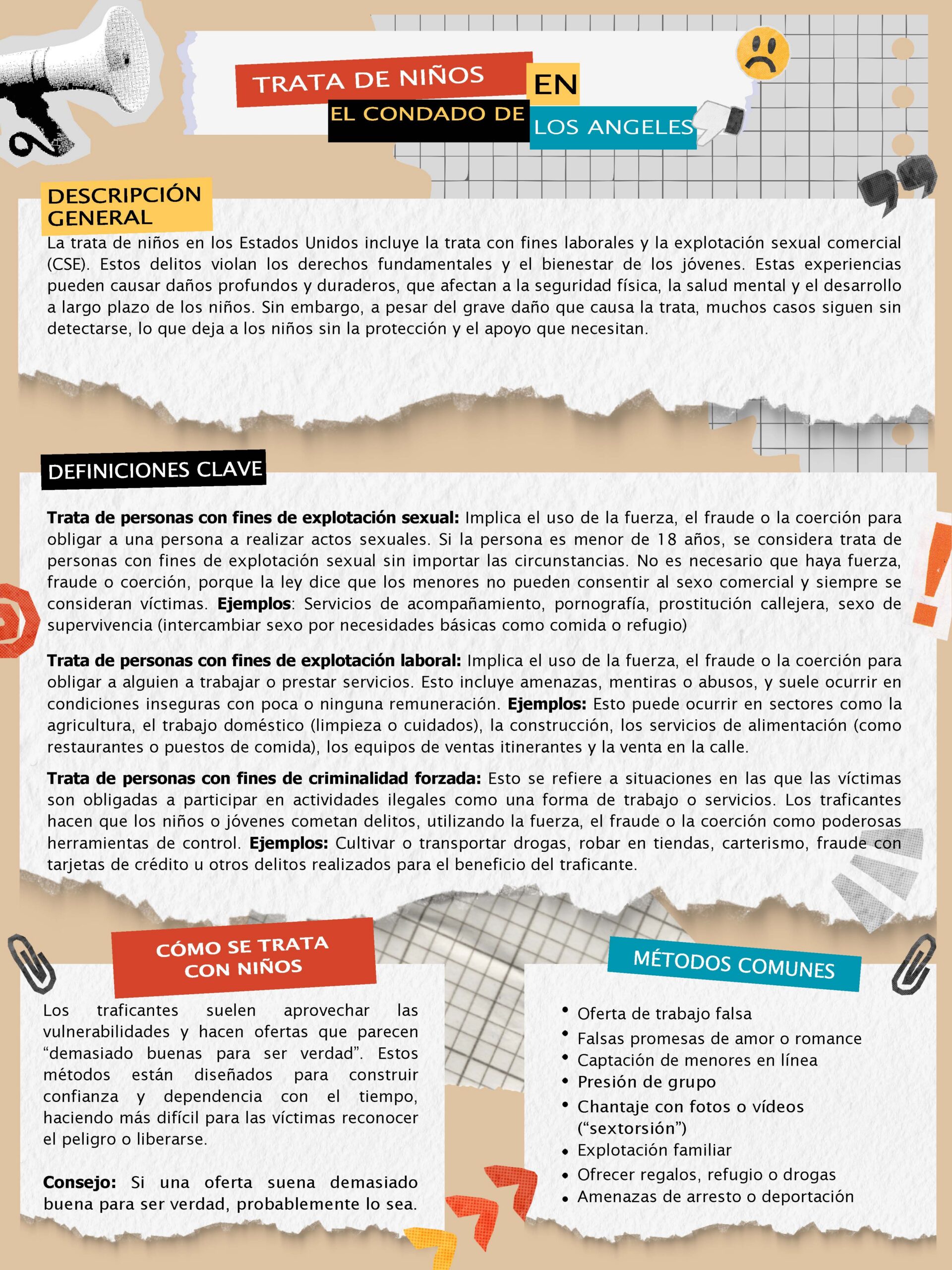
Some children and youth are trafficked through forced criminality, meaning they are made to commit crimes as a form of labor. This can include selling or transporting drugs, shoplifting, burglary, or financial fraud. Trafficking into sexual labor can also be a form of forced criminality, where young people are forced or coerced into commercial sex acts that are illegal under the law.
In both situations, traffickers use force, fraud, or coercion to exert control, often threatening arrest, jail time, or deportation if the youth refuse. While these acts may appear to be criminal behavior, in reality these young people are victims – coerced into committing crimes for someone else’s benefit.
Gang Involvement and Violence
In some cases, gangs play a direct role in human trafficking, using intimidation or violence to recruit young people or keep them trapped in trafficking situations. For many youth, this combination of violence and gang involvement makes it even more dangerous to seek help or escape exploitation. As part of this control, gangs may also force youth to participate in crimes such as drug sales, theft, or carrying weapons, blurring the line between trafficking and gang activity. These dynamics can increase mistrust of authorities and make it harder for youth to be recognized as victims rather than offenders.
Why This Matters for Identification and Response
Forced criminality and peer recruitment are often hidden or misunderstood aspects of trafficking. Without awareness, young people can be overlooked, mislabeled, or even punished when they should be protected. Recognizing these patterns helps law enforcement, schools, and communities identify victims earlier, provide appropriate services, and disrupt the tactics traffickers use to exploit children and youth. Addressing these forms of trafficking is essential to ensuring no young person falls through the cracks.
THE STRATEGIC PLAN
Introducing the Five-Year Strategic Plan
Child trafficking is a complex issue rooted in poverty, racism, and other systemic inequities. While Los Angeles County has taken important steps to improve identification, intervention, and survivor support, thousands of vulnerable children and youth still face significant barriers to safety and recovery.
To address this, Los Angeles County has developed a Five-Year Strategic Plan to Prevent and Address Child Trafficking. This comprehensive plan is a call to action for systems, service providers, and communities to create a county where every young person is safe, supported, and free from exploitation. Building on past efforts, it identifies where gaps remain and offers new, innovative ways to move forward.
The Plan is guided by three key goals:
- Goal 1: Reduce the number of youth and families impacted by human trafficking.
- Goal 2: Improve youth and family well-being and healthy youth development.
- Goal 3: Promote healthy family environments and social connectedness.
At its core, the Plan focuses on preventing the exploitation of all youth by supporting and uplifting the strengths of families and communities across the County.
Community Collaboration
The Plan was developed by experts across multiple sectors in Los Angeles County, such as public health, child welfare, health services, probation, and mental health agencies, along a wide range of community-based organizations, parents, and youth. Over 80 youth and family members contributed their voices, insights, and expertise through listening sessions, helping to ensure the Plan is grounded in real-world needs and lived experiences—particularly those of young people directly impacted by trafficking. This collaborative effort was further supported by guidance provided from the Los Angeles County Child Trafficking Steering Committee, the National Center for Youth Law, the Preventing and Addressing Child Trafficking (PACT) Project, the Commercially Sexually Exploited Children (CSEC) Action Team, and the Sunita Jain Anti-Trafficking Initiative at Loyola Marymount University.
The Plan is centered on building protective factors at the individual, familial, and community level—recognizing that preventing child trafficking requires not only addressing risk but also strengthening the environments that keep children safe and supported.
Our Approach
The Strategic Plan takes a three-pronged approach to preventing and addressing child trafficking in Los Angeles County:
1. A Public Health and Community-Based Response
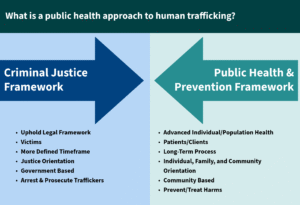
The Plan moves away from relying solely on juvenile justice and child welfare systems. Instead, it takes a public health approach that addresses the root causes of trafficking (like poverty and systemic inequities), promotes community-based solutions, and brings people and organizations together around prevention and early intervention, while also acknowledging the realities of both commercial sexual exploitation and labor trafficking. This approach includes ongoing collaboration with law enforcement agencies to promote trauma-informed, youth-centered practices that prioritize safety, trust-building, and access to services over punitive responses. It also expands engagement with community-based organizations and school districts, ensuring that children and families at risk for trafficking are connected with resources and support, and that survivors and their families have pathways to healing and recovery from exploitation.
2. A Focus on Narrative Change
The Plan is driven by the need to shift how human trafficking is understood and addressed by the public, service providers, and systems. It works to challenge harmful labels and assumptions about children and youth, and reduce stigma by recognizing that youth impacted by trafficking come from diverse backgrounds. With this in mind, the Plan encourages us to move beyond stereotypes and center youth voices in how we talk about trafficking and who receives support.
3. Grounded in Core Principles and Best Practices
The Plan is built on values that ensure the response to trafficking is thoughtful, inclusive, and centered on healing. These guiding principles are reflected throughout the Plan’s goals and strategies:
- Equity, Inclusion, and Intersectionality: Making sure all youth are treated fairly, and that support takes into account the different challenges they may face because of their race, gender, income, disability or other aspects of who they are.
- Healthy Youth Development and Self-Determination: Supporting every young person’s right to thrive and to define their own path
- Ethical and Authentic Youth and Lived-Experience Engagement: Involving youth and families in real and respectful ways, not just for show.
- Trauma-Informed Care: Understanding how trauma affects people and creating safe, supportive spaces where they can heal.
- Harm Reduction: Making space for youth to define what safety looks like for them and supporting safer options without judgment or punishment.
- Intergenerational Approaches: Supporting not just youth, but their families and communities, to break cycles of harm and promote healing across generations.
Building Bridges: How Los Angeles County Came Together to Support Children and Youth Impacted by Commercial Sexual Exploitation
Los Angeles County, in partnership with the National Center for Youth Law, is proud to release a new report, “Building Bridges: How Los Angeles County Came Together to Support Children and Youth Impacted by Commercial Sexual Exploitation.” This report lays out the County’s efforts, highlighting the individual champions who have been instrumental along the way.
Referenced in the report and provided below are Los Angeles County board motions, specialized protocols, educational videos, curricula, research, and additional resources, all focused on one primary goal—more effectively serving and supporting youth both to prevent exploitation from occurring and to intervene effectively, when necessary. The County hopes that this comprehensive report and these accompanying resources will offer ideas, strategies, and hope for other jurisdictions.
Board Motions
Task Force Motion – 11/27/2012
Task Force Motion Amendment – 11/27/2012
Task Force Motion – 9/24/2013
Task Force: ILT Motion – 10/16/2015
Training for Foster Care Providers Motion – 3/25/2014
Training for Foster Care Providers Motion – 6/24/2014
Motel Hotel Training Education Motion – 3/3/2015
Motel Hotel Training Education Motion Amendment – 3/3/2015
Motel Hotel Training Education Motion Revision – 3/3/2015
Motel Hotel Training Education Revision Motion – 3/3/2015
Countywide CSEC Training Motion – 11/14/2017
Housing Solutions Motion – 3/10/2015
Housing Solutions Motion Revised – 5/12/2015
Housing Recovery Solutions Expansion Motion – 7/9/2019
Housing Solutions Research Motion Amendment – 7/9/2019
Safe Youth Zone Motion – 6/16/2015
Safe Youth Zone Motion – 5/10/2016
Safe Youth Zone Expansion Motion – 6/9/2020
SB 1193 Motion – 2/11/2014
Zero Tolerance Motion – 10/4/2016
Parent Services Motion (PEP) – 11/28/2017
Parent Services Motion (PEP) revised – 11/28/2017
First Responder Protocol Evaluation Motion – 11/13/2018
Preventing Human Trafficking in the Wake of Natural Disasters – 4/1/2025
Moving Forward with Recommendations to Reimagine Los Angeles County’s Approach to Human Trafficking – 2/4/2025
Establishing New Reporting & Accountability Structure for the Child Trafficking Strategic Plan – 8/6/2024
Resources and Research
Law Enforcement First Responder Protocol (FRP) for CSEC
FRP 4 Year Report
FRP 6 Year Report
Detention Interagency Identification and Response Protocol for CSE Children and Youth
Word on the Street CSEC Prevention Curriculum
Intervention Curriculum Fact Sheet – coming soon
Parent Empowerment Program Fact Sheet – coming soon
CSEC Housing Research Report
CSE Research to Action Brief
Assessment of the Law Enforcement First Responder Protocol for CSEC
Training Calendar – coming soon
Events – coming soon
Agency Contact Information – coming soon
Ending Commercial Sexual Exploitation of Children: A Call for Multi-System Collaboration in California
All Hands on Deck: Identifying and Supporting Commercially Sexually Exploited Youth in the Juvenile Justice System
Training Summary
ARIZONA STATE UNIVERSITY SCHOOL OF SOCIAL WORK
TRAFFICKING BROCHURES
- Teen Sex Trafficking Awareness
- School Educators and School Admin
- Parents
- Mental Health
- Health Care
- EMS
- Child Welfare
- Adult Probation
CALIFORNIA DEPARTMENT OF SOCIAL SERVICES
HARM REDUCTION SERIES
Law Enforcement First Responder Protocol for CSEC
In 2012, Los Angeles County was identified as a major hub for the commercial sexual exploitation of children. Adult traffickers were preying upon children, some as young as 10 years old, and forcing them to sell their bodies for money in our local streets night after night. As a result of a history of abuse and neglect prior to their exploitation, many of these children have been involved in the County’s child welfare system.
Despite being victims of exploitation, these children were routinely criminalized for behavior they were forcefully manipulated into by their exploiters. The County’s child-serving agencies, as well as law enforcement, were brought together to create a countywide response and train staff to identify and better serve child victims of sexual exploitation.
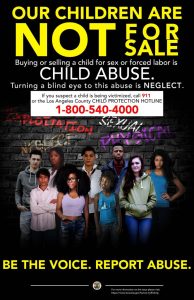
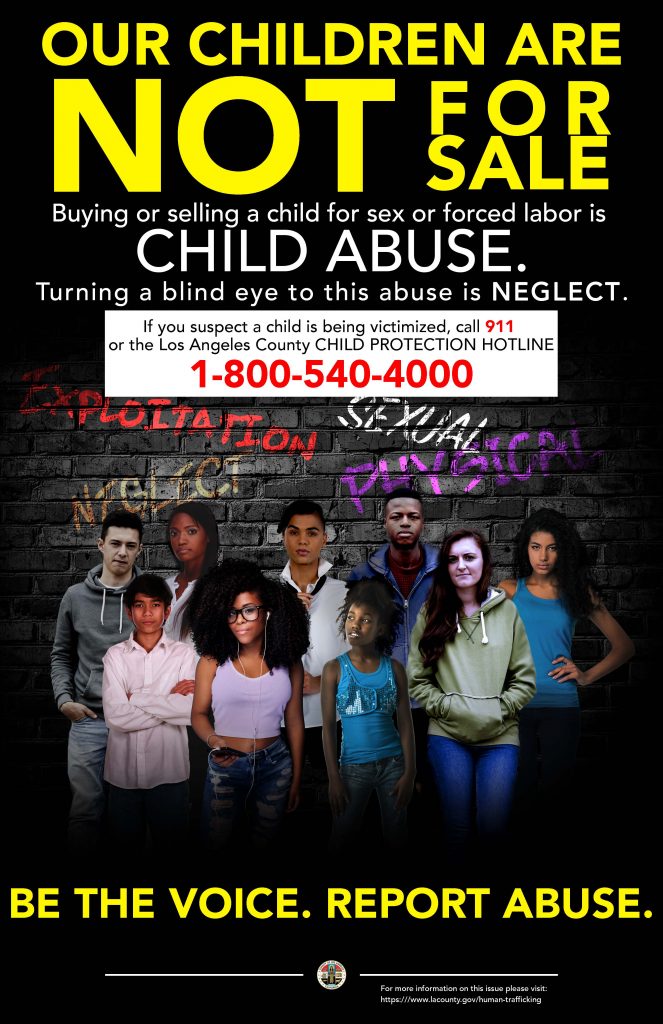
With the Los Angeles County Law Enforcement First Responder Protocol for Commercially Sexually Exploited Children, we have created a system in which law enforcement officers can identify victims of sexual exploitation and work collaboratively with County agencies and community-based organizations to avoid arrest, keep them safe and provide them with the services they need to escape exploitation. Identifying and engaging youth at this first point of contact will help keep victims of extreme sexual abuse from being criminalized. Together with law enforcement and our non-profit partners, Los Angeles County stands united in saying: “Our children are not for sale.”
For questions or more information, contact:
Adela Estrada
Department of Children and Family Services
ESTRAA@dcfs.lacounty.gov