



October 1, 2026
Media Contact:
Tara Atrian (323) 610-9840
press@ad.lacounty.gov
DEO Media Contact:
Angela Herrera Perez
press@opportunity.lacounty.gov
Turn On Captions: L.A. County Launches Campaign to Make Public Spaces More Accessible
Public education campaign supports new closed-captioning requirements in places of public accommodation in unincorporated Los Angeles County
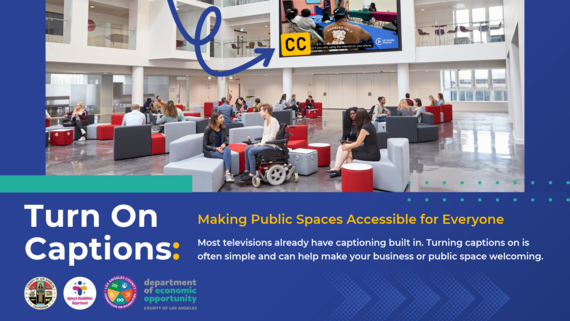
LOS ANGELES, CA — The Los Angeles County Aging & Disabilities Department (AD), in partnership with the Department of Economic Opportunity (DEO), today launched “Turn On Captions,” a public education and outreach campaign to increase awareness and understanding of new closed-captioning accessibility requirements in places of public accommodation in the unincorporated areas of Los Angeles County. The campaign follows the Los Angeles County Board of Supervisors’ September 29, 2026, approval of an ordinance adding Chapter 11.67, Closed Captioning in Places of Public Accommodation, to Title 11 of the Los Angeles County Code.
Los Angeles County Supervisor Holly J. Mitchell, who authored the motion calling for the ordinance, shared, “A simple step like turning on closed captions goes a long way in expanding access to information for everyone. It’s a small switch that can make a big difference for our Deaf and hard-of-hearing neighbors, English learners, neurodivergent residents, and any person who could use a little extra support with taking in what’s on the screen. LA County is helping our small businesses and community partners in our unincorporated communities get ready now for the January 1, 2027, start date. Join us in making our public spaces more welcoming and inclusive for everyone.”
Beginning January 1, 2027, places of public accommodation in unincorporated Los Angeles County must ensure closed captioning is activated on capable televisions in public areas during regular business hours, subject to the exceptions outlined in the ordinance.
Places of public accommodation covered by the ordinance include, but are not limited to, hotels and other lodging establishments, restaurants and cafeterias, theaters and other entertainment venues, sports arenas and stadiums, retail establishments, barber and beauty shops, medical facilities, government offices and other places where the public gathers or receives goods or services.
The ordinance provides that when multiple televisions are displaying the same channel or program, closed captioning is not required on more than one out of every five televisions. The requirement does not apply if there is no television available in a public area or if the television is incapable of displaying closed captioning.
Why Captions Matter
Closed captions can benefit people who are D/deaf or hard of hearing, as well as English language learners, people developing literacy skills, neurodivergent individuals, older adults, people watching television in noisy environments, and others who benefit from reading along.
More than 800,000 people in the Greater Los Angeles region have some level of hearing loss, according to the Hearing Education and Research Center (HEAR Center), as cited in the Board’s motion that initiated this effort.
Research also shows that captions can improve comprehension, attention and memory for viewers of all ages and abilities.
Supporting Greater Access
The Turn On Captions campaign provides educational information and resources for businesses, organizations, community partners and the public. AD is leading the public education campaign, while DEO is supporting business outreach and engagement with business associations, chambers of commerce and other business stakeholders. Campaign materials will be available through the web hub and shared through community-based organizations, County communication channels and other outreach efforts. The campaign includes multilingual educational materials and incorporates input from the D/deaf and hard of hearing community.
“Closed captioning turns spoken words, sound effects and emotional tones into clear visual text, providing greater accessibility and inclusion,” said Los Angeles County Commission on Disabilities (LACCOD) Commissioner Michael Agyin, who initiated the effort to establish a County closed-captioning ordinance. “It helps ensure that Deaf and hard-of-hearing viewers, as well as many others in L.A. County, can access and experience every story fully, independently and without missing important details. While closed captioning is necessary for some, it creates a better viewing experience for everyone.”
“Turning on closed captions is a simple step that can make a meaningful difference in how people experience public spaces,” said Maral V. Karaccusian, Director of the Aging & Disabilities Department. “Our goal with this campaign is to make accessibility part of the everyday experience of visiting a business, receiving a service, or spending time in a public space. We want people to know that access and inclusion are not separate from the way we serve our communities.”
“Accessibility and economic opportunity go hand in hand. Through the Turn On Captions campaign, we’re working to make sure businesses across unincorporated Los Angeles County have the information and support they need to understand these new requirements and prepare for implementation,” said Kelly LoBianco, Director of the Los Angeles County Department of Economic Opportunity. “Turning on captions is a simple action that can help businesses create more welcoming and accessible spaces for customers of all abilities, while strengthening the inclusive communities they serve.”
The County’s education campaign begins today, ahead of the January 1, 2027 deadline, to give places of public accommodation time to learn about the new requirements and prepare for implementation.
Members of the public can learn more, submit questions and feedback, and share their stories about closed captioning through the campaign hub.
Learn More
Visit the Turn On Captions campaign hub for information, resources and ways to participate: ad.lacounty.gov/turn-on-captions/
###
About the Aging & Disabilities Department
The Los Angeles County Aging & Disabilities Department (AD) serves the Los Angeles region’s growing population of older adults and adults with disabilities with thoughtful action, compassion, and supportive programs. Through its advocacy and dedicated efforts, the department works to connect people to resources, protect their dignity, and foster independence.
This mission is guided by the belief that every individual, regardless of age or ability, deserves to lead a fulfilling and dignified life, enriched by the involvement and support of their community.
About the Department of Economic Opportunity
The L.A. County Department of Economic Opportunity (DEO) has a vision for a more equitable economy with thriving communities, inclusive and sustainable growth, and opportunity and mobility for all. The department, with its America’s Job Centers of California, Office of Small Business, L.A. County Film Office, and hundreds of programs and partners, creates quality jobs, helps small businesses and high-road employers start and grow, and builds vibrant communities and spaces.